

Nel panorama concettuale spagnolo, Berta Jayo (Santander) ha dimostrato una traiettoria critica che, pur mutando soggetto, mantiene un rigore quasi chirurgico nella sua “natura non conformista, critica e innovatrice“. Abbandonati gli archetipi religiosi, la Jayo si è immersa in una riflessione più archetipica e monumentale con la serie “Cabezas hechas con libros” (Teste fatte con libri). Questa serie non è un’esibizione di craftsmanship, ma un potente dispositivo critico-filosofico che usa la scultura come lente d’ingrandimento sul corpus del sapere occidentale.
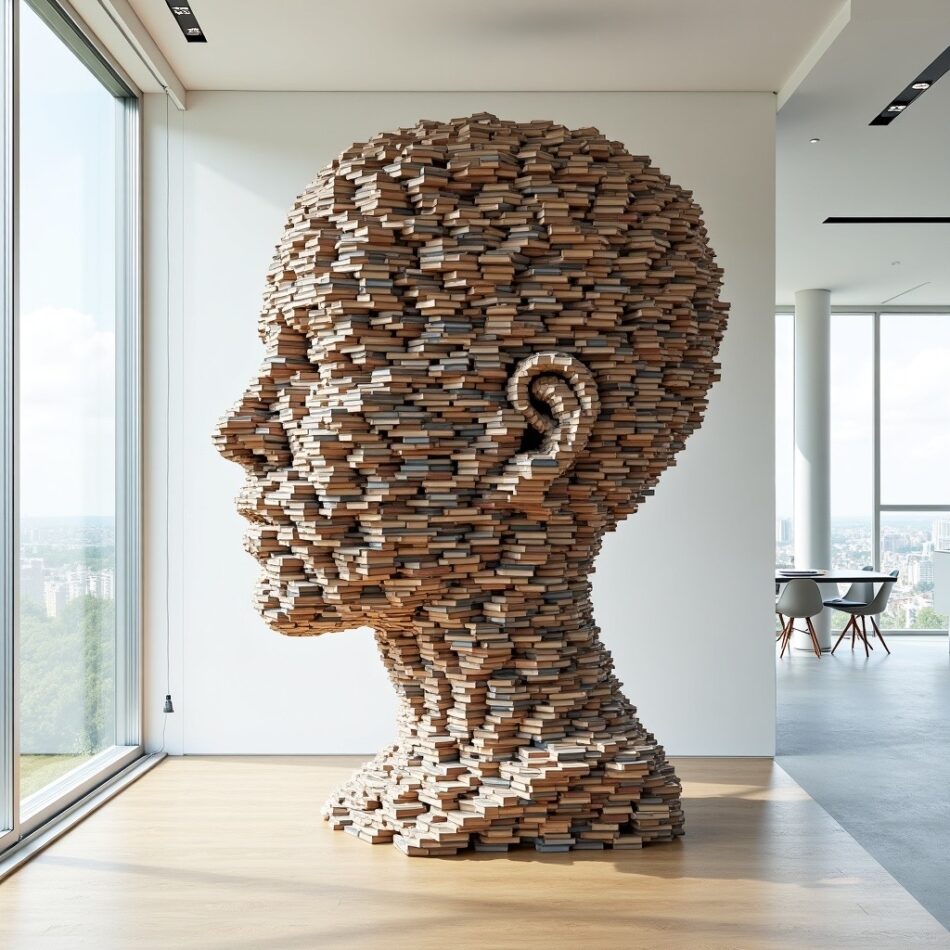
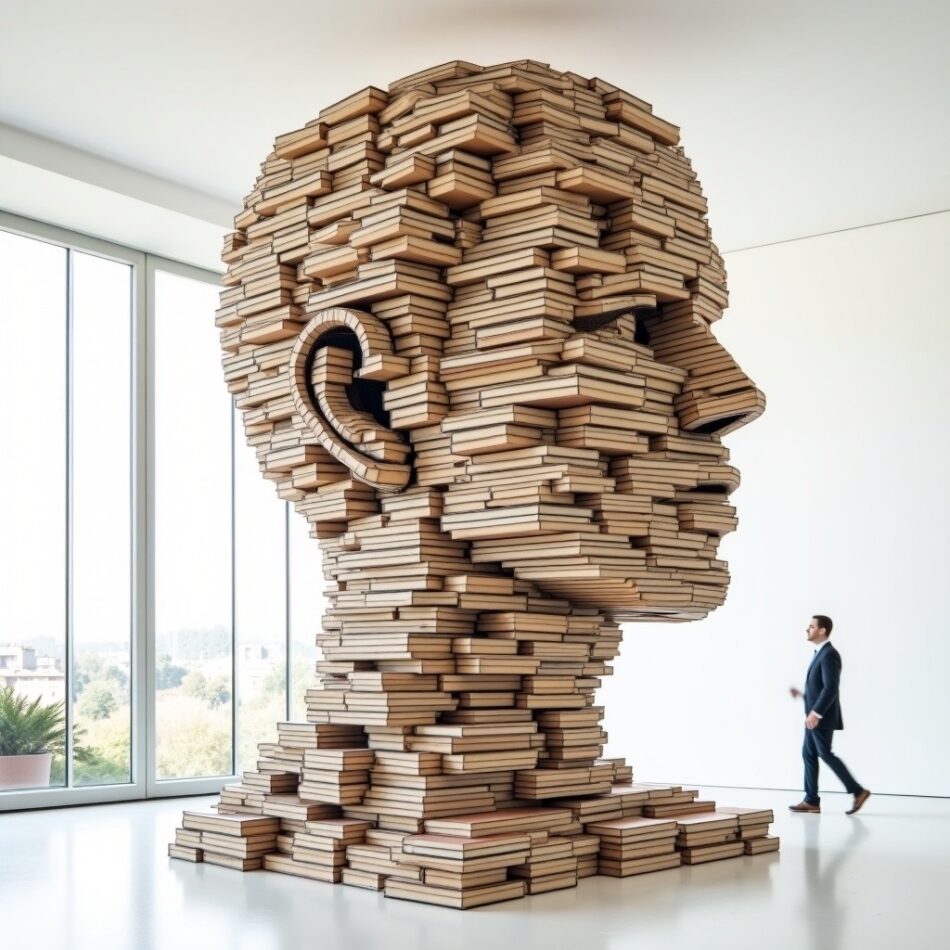
Le opere, come si evince chiaramente dalle immagini, sono monoliti di conoscenza, volti titanici la cui materialità è interamente costituita da pagine di libri stratificate. L’artista ci costringe a confrontare l’individuo con il suo peso intellettuale. La testa, organo del pensiero individuale, è fusa con i libri, simbolo della memoria collettiva e del sapere codificato, riflettendo l’idea che “libri e letteratura sono i pilastri su cui la società e la cultura sono costruite“. Ma se sono pilastri, essi formano anche un Atlante di Carta costretto a sostenere sulle spalle il carico schiacciante della storia e del canone.
La Jayo sfrutta la materialità del libro per amplificare il dialogo irrisolto tra l’Io e l’Archivio. Non siamo di fronte a un flusso lineare, ma a una sedimentazione complessa e a un tempo geologico in cui ogni strato di cellulosa rappresenta un secolo o un’idea inglobata. L’uso dei libri come materia d’arte, in un’epoca dominata dal cloud e dal digitale, carica l’opera di un senso di relitto o rovina archeologica: il libro è un artefatto sacro in via di estinzione e la Jayo gli innalza un monumento alla sua stessa potenziale obsolescenza, in un atto di meta-critica sulla forma stessa della trasmissione del sapere.
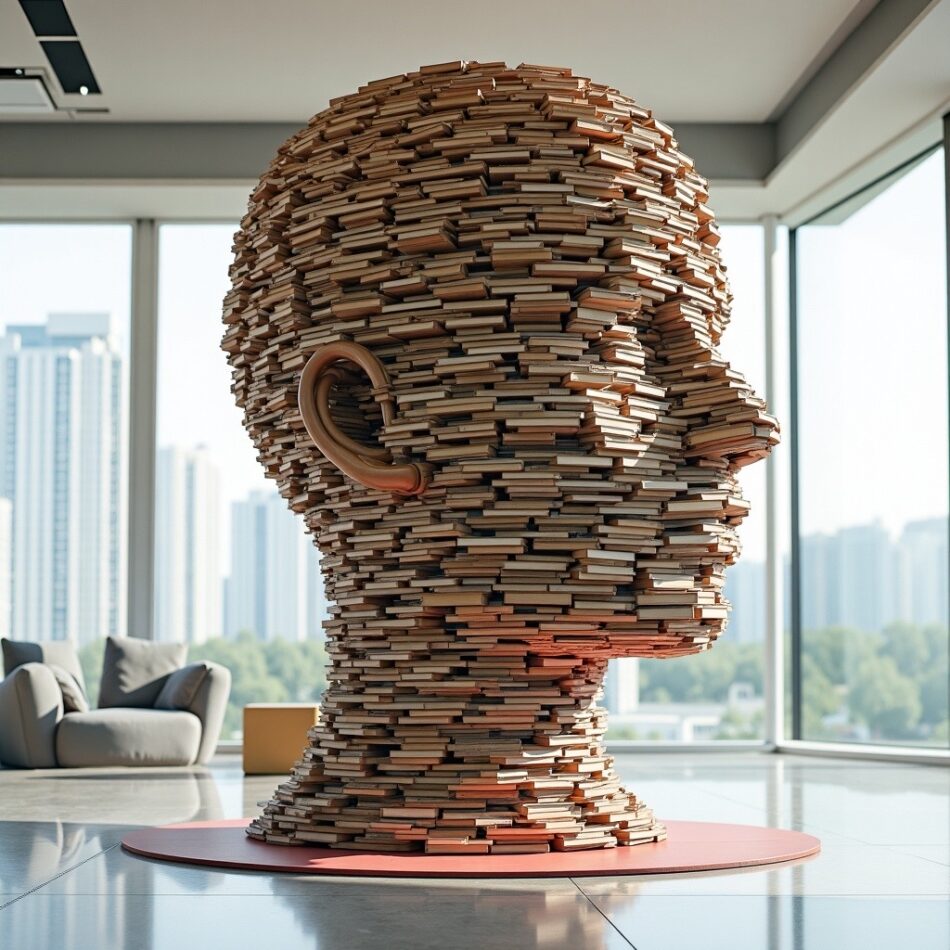
Il paradosso si accentua nel silenzio di queste icone. L’imponenza delle teste maschili suggerisce l’autorità intellettuale del Canone culturale – un Golem di carta la cui vita è data dalla somma dei testi – ma, pur essendo costruite dal sapere, non parlano. I libri sono sigillati, muti nella loro nuova funzione scultorea. Questa afonia è una critica all’intellettualismo fine a sé stesso, che accumula conoscenza senza tradurla in consapevolezza critica. La drammatica massa e il peso visivo suggeriscono, infine, il carico insopportabile della tradizione: l’identità contemporanea è costretta a portare sulle spalle l’intera biblioteca del passato, trasformando la testa non in un contenitore di idee, ma nel supporto di un fardello che minaccia di schiacciare l’intuizione individuale.
La Jayo compie un’immersione nel nostro io collettivo. La sua arte è la prova che l’Arte, lungi dall’essere solo forma e linguaggio, è un supremo veicolo di pensiero critico che riapre vortici di interrogativi sul rapporto tra l’individuo e il volume (e il peso) della storia.
Instagram: @bertajayo
https://www.singulart.com/fr/artiste/berta-jayo-78344?ref=ts&view=serie
§§§
English Version
The Paper Atlas: Berta Jayo and the Monumental Weight of the Canon
In the Spanish conceptual landscape, Berta Jayo (Santander) has demonstrated a critical trajectory that, while changing subject matter, maintains an almost surgical rigor in its “nonconformist, critical, and innovative nature.” Having abandoned religious archetypes, Jayo has immersed herself in a more archetypal and monumental reflection with the series “Cabezas hechas con libros” (Heads made with books). This series is not an exhibition of craftsmanship, but a powerful critical-philosophical device that uses sculpture as a magnifying glass on the corpus of Western knowledge.
The works, as clearly seen in the images, are monoliths of knowledge, titanic faces whose materiality is entirely constituted by stratified book pages. The artist compels the individual to confront their intellectual weight. The head, the organ of individual thought, is fused with books, the symbol of collective memory and codified wisdom, reflecting the idea that “books and literature are the pillars on which society and culture are built.” But if they are pillars, they also form a Paper Atlas forced to bear the crushing burden of history and the canon on its shoulders.
Jayo exploits the materiality of the book to amplify the unresolved dialogue between the Self and the Archive. We are not faced with a linear flow, but with a complex sedimentation and a geological time where every layer of cellulose represents an incorporated century or idea. The use of books as artistic matter, in an era dominated by the cloud and digital technology, loads the work with a sense of relic or archaeological ruin: the book is a sacred artifact facing extinction, and Jayo erects a monument to its own potential obsolescence, in an act of meta-critique on the very form of knowledge transmission.
The paradox is accentuated in the silence of these icons. The imposing scale of the male heads suggests the intellectual authority of the Cultural Canon—a Paper Golem whose life is given by the sum of texts—but, despite being constructed by knowledge, they do not speak. The books are sealed, mute in their new sculptural function. This aphonia is a critique of intellectualism for its own sake, which accumulates knowledge without translating it into critical awareness. The dramatic mass and visual weight finally suggest the unbearable burden of tradition: contemporary identity is forced to carry the entire library of the past on its shoulders, transforming the head not into a container of ideas, but into the support for a burden that threatens to crush individual intuition.
Jayo accomplishes an immersion into our collective self. Her art is proof that Art, far from being just form and language, is a supreme vehicle for critical thought that reopens vortices of questioning about the relationship between the individual and the volume (and the weight) of history.
Lascia un commento